Introduction: A New Era for Western Hyderabad
On February 11, 2026, the Greater Hyderabad Municipal Corporation (GHMC) underwent a historic transformation that will reshape urban governance in India’s tech capital for decades to come. After months of speculation, the Telangana government officially trifurcated GHMC into three independent municipal corporations: the Greater Hyderabad Municipal Corporation (GHMC), the Malkajgiri Municipal Corporation (MMC), and the Cyberabad Municipal Corporation (CMC). This reorganization marks one of the most significant administrative reforms in Hyderabad’s modern history, affecting millions of residents and thousands of businesses across the metropolitan region.
For residents of western and northwestern Hyderabad—particularly those living in India’s premier IT corridor—the creation of the Cyberabad Municipal Corporation represents both a promise and a challenge. The promise is that of more focused, efficient, and responsive local governance tailored to the unique needs of this rapidly growing urban cluster. The challenge lies in successfully transitioning from decades of unified administration to a new, decentralized model that must prove its worth in the months and years ahead.
This comprehensive guide will walk you through everything you need to know about the Cyberabad Municipal Corporation: its formation, jurisdiction, administrative structure, services, leadership, and what it means for the future of Hyderabad’s western corridor.
The Historical Context: From Merger to Trifurcation
To understand the significance of CMC’s creation, we must first look back at the events that led to this moment.
The 1955 Beginning
The Municipal Corporation of Hyderabad was first constituted in 1955, shortly after Hyderabad State was reorganized and merged into India. For over five decades, this civic body served the historic core of the city with distinction, maintaining the infrastructure and public services that made Hyderabad one of India’s most livable cities.
The 2007 GHMC Expansion
As Hyderabad grew rapidly in the late 20th and early 21st centuries, fueled by the IT boom and infrastructure development, the original municipal boundaries became increasingly inadequate. In 2007, the government took a bold step by expanding the Municipal Corporation of Hyderabad into the Greater Hyderabad Municipal Corporation (GHMC) through the merger of 12 surrounding municipalities. This expansion recognized the reality of urban sprawl and attempted to create a unified governance structure for the metropolitan region.
The December 2025 Mega-Merger
Nearly two decades later, Hyderabad had once again outgrown its administrative boundaries. The city’s explosive growth—particularly in the IT corridor, pharmaceutical clusters, and residential suburbs—necessitated another expansion. In December 2025, the Telangana government made the momentous decision to merge 27 Urban Local Bodies (ULBs) into GHMC, dramatically expanding its jurisdiction from 650 square kilometers to an unprecedented 2,053 square kilometers. This transformation effectively elevated Hyderabad to the status of a megacity, with the expanded GHMC overseeing 300 wards organized into 12 zones and 60 circles.
The December 2025 merger was driven by the Core Urban Region Economy (CURE) framework, which aimed to ensure uniform service delivery, integrated planning, and faster implementation across the entire metropolitan region. The vision was ambitious: a single, powerful civic authority capable of managing one of India’s largest and most dynamic urban areas.
The February 2026 Trifurcation
However, the practical challenges of managing such a vast territory soon became apparent. A single municipal corporation overseeing 2,053 square kilometers and 300 wards would struggle to provide efficient, localized services. The administrative span of control was simply too broad, and the diverse needs of different urban clusters—from the historic Old City to the modern IT corridor to the emerging eastern suburbs—required more specialized attention.
On February 11, 2026, following the conclusion of the GHMC council’s term on February 10, the Telangana government issued Government Orders (G.O. Ms. Nos. 55 and 56) reorganizing the expanded area into three distinct municipal corporations. This trifurcation, while reducing the scale of each individual corporation, promised to deliver more focused governance and faster service delivery.
The decision was both pragmatic and strategic. By creating three corporations with clearly defined jurisdictions, the government sought to:
- Decentralize decision-making and bring administration closer to citizens
- Enable specialized management suited to each region’s unique characteristics
- Improve responsiveness and accountability
- Foster healthy competition among the three corporations for better performance
- Manage the administrative workload more effectively
Cyberabad Municipal Corporation: Jurisdiction and Geography
The Cyberabad Municipal Corporation is responsible for governing the western and northwestern corridor of the Hyderabad metropolitan region—an area that has emerged as India’s leading IT and innovation hub over the past two decades.
Coverage Area
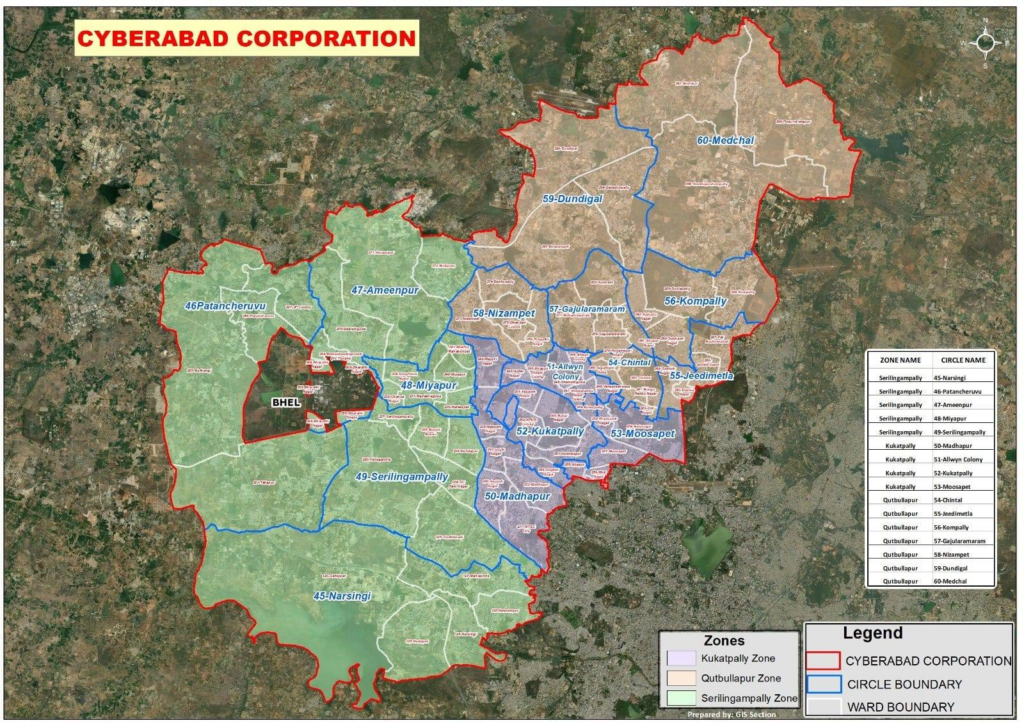
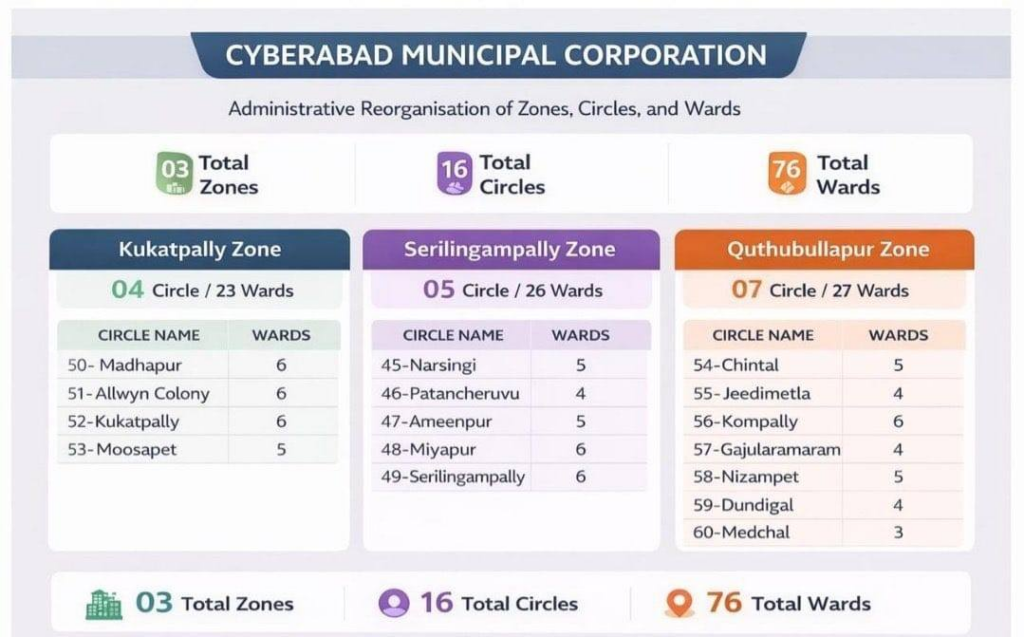
CMC comprises three zones, 16 circles, and 76 wards, spanning some of Hyderabad’s most economically dynamic and rapidly growing neighborhoods. The corporation’s jurisdiction includes:
Serilingampally Zone (5 circles, 26 wards):
- Narsingi Circle
- Patancheru Circle
- Ameenpur Circle
- Miyapur Circle
- Serilingampally Circle
Kukatpally Zone (4 circles, 23 wards):
- Madhapur Circle
- Allwyn Colony Circle
- Kukatpally Circle
- Moosapet Circle
Quthbullapur Zone (7 circles, 27 wards):
- Chintal Circle
- Jeedimetla Circle
- Kompally Circle
- Gajularamaram Circle
- Nizampet Circle
- Dundigal Circle
- Medchal Circle
The IT Corridor: Heart of Cyberabad
The crown jewel of the Cyberabad Municipal Corporation’s jurisdiction is undoubtedly the IT corridor, centered around HITEC City (Hyderabad Information Technology and Engineering Consultancy City) and its surrounding areas. Established in 1998 under the visionary leadership of then-Chief Minister N. Chandrababu Naidu, HITEC City has grown from a bold experiment into one of Asia’s premier technology clusters.
Spread across 200 acres in the Madhapur area, HITEC City is home to some of the world’s largest and most innovative technology companies. Microsoft opened its first Indian R&D center here in 1998, occupying space in the iconic Cyber Towers building. Since then, tech giants including Google, Amazon, Facebook (now Meta), Oracle, Apple, Infosys, TCS, Wipro, Cognizant, and hundreds of others have established major operations in and around HITEC City.
The IT corridor extends far beyond the original HITEC City boundaries, encompassing:
Gachibowli: Home to major campuses including Amazon’s largest owned building worldwide (spanning 9.5 acres with capacity for over 15,000 employees), Microsoft’s 56-acre R&D campus, and numerous other corporate facilities. The area also hosts prestigious educational institutions like the Indian School of Business (ISB) and the International Institute of Information Technology (IIIT-H).
Madhapur: The original HITEC City location, featuring landmark buildings like Cyber Towers, Cyber Gateway, and numerous IT parks housing both multinational corporations and innovative startups.
Kondapur: A rapidly developing area with multiple IT parks, SEZs (Special Economic Zones), and residential communities catering to the tech workforce.
Nanakramguda and Manikonda: Extensions of the IT corridor with newer office complexes, startup incubators, and mixed-use developments.
Financial District: While technically part of Gachibowli, this area deserves special mention as a planned commercial hub designed to rival international financial centers, hosting banks, financial institutions, and corporate headquarters.
The IT sector’s presence in Cyberabad contributes over $30 billion in annual exports, generates millions of direct and indirect jobs, and serves as a magnet for global talent and investment. This economic powerhouse requires sophisticated urban management—a key reason why the creation of CMC makes strategic sense.
Beyond IT: A Diverse Urban Landscape
While the IT corridor dominates popular imagination, the Cyberabad Municipal Corporation’s jurisdiction encompasses much more than tech parks and corporate campuses. The region includes:
Industrial Clusters: Areas like Jeedimetla, Balanagar, and parts of Quthbullapur host traditional manufacturing, pharmaceuticals, engineering, and small-scale industries that provide employment to hundreds of thousands of workers.
Residential Communities: From upscale gated communities in Kondapur and Gachibowli to middle-class neighborhoods in Kukatpally and affordable housing in Miyapur and Nizampet, CMC serves a socio-economically diverse population.
Educational Institutions: The region hosts numerous schools, colleges, and universities, making it an educational hub alongside its technology focus.
Healthcare Facilities: Major hospitals and healthcare networks have established facilities across CMC’s jurisdiction, providing world-class medical services.
Commercial Centers: Shopping malls, markets, entertainment complexes, and retail districts serve the consumer needs of the region’s affluent and growing population.
Agricultural and Semi-Urban Areas: The outer reaches of CMC’s jurisdiction, particularly in Patancheru, Dundigal, and Medchal circles, still retain semi-urban and agricultural characteristics, presenting unique governance challenges as urbanization continues.
Administrative Structure and Leadership
The Cyberabad Municipal Corporation is led by a team of experienced administrators tasked with managing one of India’s most economically significant urban regions.
Top Leadership
Commissioner: G. Srijana, IAS, has been appointed as the first Commissioner of the Cyberabad Municipal Corporation. As an Indian Administrative Service officer, Commissioner Srijana brings valuable experience from her previous role as Additional Commissioner of GHMC. Her appointment signals the government’s commitment to ensuring strong, capable leadership for the new corporation.
The Commissioner is the chief executive authority of CMC, responsible for overall administration, policy implementation, financial management, and coordination with state and central governments. The Commissioner’s office is located at the National Academy of Construction building near HITEX, Madhapur strategically positioned in the heart of the IT corridor.
Special Officer: Sri Jayesh Ranjan, IAS, who serves as Special Chief Secretary for Municipal Administration and Urban Development (MA&UD), has been appointed as the Special Officer overseeing all three municipal corporations (GHMC, CMC, and MMC). This arrangement ensures coordination and consistency across the three bodies during the critical transition period.
Zonal Leadership
The three zones of CMC are each headed by a Zonal Commissioner, providing localized leadership and decision-making:
Kukatpally Zone: Sri Apurv Chauhan, IAS Quthbullapur Zone: Sri Sandeep Kumar Jha, IAS Serilingampally Zone: Sri Bhorkhade Hemant Sahadeorao, IAS (Email: zc.west.ghmc@gmail.com)
These Zonal Commissioners serve as the primary interface between citizens and the corporation at the zone level, overseeing day-to-day operations, addressing local issues, and implementing CMC policies within their respective jurisdictions.
Deputy Commissioners
The operational backbone of CMC consists of 16 Deputy Commissioners, one for each circle. These officers are responsible for the ground-level delivery of civic services, supervision of ward staff, resolution of citizen complaints, and implementation of development projects. The current Deputy Commissioners are:
Quthbullapur Zone:
- D. Lavanya – Chintal Circle (Contact: 8639601877)
- N. Sudhamsh – Medchal Circle (Contact: 9963854999)
- Md. Saber Ali – Nizampet Circle (Contact: 7729003999)
- N. Krishna Reddy – Kompally Circle (Contact: 7997994234)
- D. Shanker Singh – Jeedimetla Circle (Contact: 9154671588)
- Sreepada Rameshwar – Gajularamaram Circle (Contact: 9440386242)
- N. Venkateshwara Naik – Dundigal Circle (Contact: 7995824449)
Kukatpally Zone: 8. B. Gangadhar – Kukatpally Circle (Contact: 8121041427) 9. N. Balakrishna – Madhapur Circle (Contact: 7842190103) 10. Seva Eslavath – Moosapet Circle (Contact: 7995079814) 11. E. Chamundeshwari – Allwyn Colony Circle (Contact: 8712495973)
Serilingampally Zone: 12. Jyoti Reddy – Patancheru Circle (Contact: 7337302638) 13. V. Prashanthi – Serilingampally Circle (Contact: 9154686542) 14. Pradeep Kumar – Ameenpur Circle (Contact: 8712419180) 15. D. Sheshi Rekha – Miyapur Circle (Contact: 8121041483 / 9000036998) 16. T. Krishna Mohan Reddy – Narsingi Circle (Contact: 9121529597)
These contact numbers represent a commitment to accessible governance, allowing citizens to directly reach their circle-level administrators with issues and concerns.
Organizational Structure
Below the Commissioner and Deputy Commissioners, CMC’s organizational structure includes:
Department Heads: Leading various functional departments such as Engineering, Public Health, Revenue, Accounts, Town Planning, and Administration.
Circle-Level Officers: Including Assistant Engineers, Health Officers, Revenue Inspectors, and other technical staff responsible for specific functions within each circle.
Ward-Level Staff: The frontline workers who interact directly with citizens, including sanitary workers, road maintenance crews, bill collectors, and field inspectors.
Support Staff: Administrative personnel, IT staff, drivers, and others who keep the corporation functioning smoothly.
Core Services and Functions
The Cyberabad Municipal Corporation is responsible for delivering a comprehensive range of civic services to residents and businesses within its jurisdiction. These services form the foundation of urban life and economic activity in western Hyderabad.
1. Water Supply and Distribution
CMC manages the complex infrastructure required to deliver potable water to millions of residents and thousands of commercial establishments. This includes:
- Water Treatment Plants: Processing water from the Krishna River and local reservoirs to meet drinking water standards
- Distribution Network: Maintaining thousands of kilometers of pipelines, pumping stations, and storage tanks
- New Connections: Processing applications for water connections for new residential and commercial properties
- Billing and Collection: Managing water bills, meter readings, and payment collection
- Quality Monitoring: Regular testing of water quality to ensure public health standards
- Leak Detection and Repair: Identifying and fixing water losses in the distribution system
- Emergency Water Supply: Providing water tankers to areas facing temporary supply disruptions
The IT corridor’s high-density development and round-the-clock operations create unique water demand patterns that CMC must manage efficiently. Additionally, the corporation is working toward the goal of 24×7 water supply across its jurisdiction, a promise that requires significant infrastructure investment.
2. Sewerage and Drainage
Managing wastewater and stormwater is critical for public health and environmental protection:
- Sewerage Network: Maintaining and expanding the network of sewer lines that collect wastewater from homes and businesses
- Sewage Treatment Plants (STPs): Operating treatment facilities that process wastewater before releasing it into natural water bodies
- New Sewerage Connections: Providing sewerage connections to newly developed areas and individual properties
- Drainage Infrastructure: Maintaining nalas (stormwater drains), culverts, and drainage systems to prevent flooding during monsoons
- Desilting Operations: Regular cleaning of drains before and during monsoon season to ensure free flow of rainwater
- Flood Prevention: Implementing flood control measures in low-lying and flood-prone areas
The rapid urbanization in CMC’s jurisdiction has put tremendous pressure on drainage infrastructure, with many traditional water channels having been encroached upon or blocked. Addressing these challenges is a top priority for the new corporation.
3. Solid Waste Management
CMC handles the collection, transportation, and disposal of thousands of tons of solid waste generated daily:
- Door-to-Door Collection: Daily collection of household waste from all wards
- Segregation at Source: Promoting and enforcing the separation of wet waste, dry waste, and hazardous waste at the household level
- Commercial Waste: Managing waste from shops, restaurants, offices, and IT parks
- Processing Facilities: Operating composting plants, recycling centers, and waste-to-energy facilities
- Sanitary Landfills: Managing scientific landfills for waste that cannot be recycled or processed
- Street Cleaning: Regular sweeping and cleaning of roads and public spaces
- Public Bins: Installing and maintaining dustbins in public areas
- Special Waste: Handling construction debris, e-waste, and biomedical waste through specialized collection mechanisms
The IT corridor generates unique waste streams, including significant e-waste and office waste, requiring specialized handling procedures. CMC is also working to eliminate open garbage dumps and promote a circular economy approach to waste management.
4. Road Infrastructure and Maintenance
CMC is responsible for a vast network of roads ranging from major arterial roads to internal colony streets:
- Road Construction: Building new roads to connect developing areas and ease traffic congestion
- Maintenance and Repair: Filling potholes, resurfacing damaged roads, and conducting regular maintenance
- Footpaths and Sidewalks: Constructing and maintaining pedestrian infrastructure
- Street Lighting: Installing and maintaining LED street lights for public safety
- Traffic Management: Coordinating with traffic police to implement traffic calming measures and improve road safety
- Signage: Installing and maintaining road signs, street name boards, and directional indicators
- Flyovers and Underpasses: Planning and constructing grade separators to ease traffic congestion at key junctions
The explosive growth of the IT corridor has led to severe traffic congestion, particularly during peak hours. CMC is planning several major infrastructure projects, including multi-level flyovers at IIIT Junction and Khajaguda Junction, to address these challenges.
5. Building Permissions and Town Planning
As one of India’s fastest-growing urban regions, CMC processes thousands of building permission applications:
- Building Plan Approvals: Scrutinizing and approving building plans for residential, commercial, and industrial constructions
- Occupancy Certificates: Issuing certificates confirming that buildings meet safety and regulatory standards
- Town Planning: Implementing master plans and zoning regulations to guide orderly development
- Violation Enforcement: Taking action against unauthorized constructions and deviations from approved plans
- Demolition Permits: Processing applications for legal demolition of structures
- Layout Approvals: Approving residential and commercial layout plans for developers
The high real estate demand in CMC’s jurisdiction has unfortunately led to numerous unauthorized constructions and deviations. The corporation is working to strengthen its enforcement mechanisms while also streamlining the approval process to reduce delays.
6. Property Tax Assessment and Collection
Property tax is CMC’s primary source of revenue, funding most of its operations:
- Property Assessment: Surveying and assessing properties to determine tax liability
- Tax Billing: Generating and distributing property tax bills
- Collection: Accepting tax payments through online portals, banks, and CMC offices
- Exemptions and Rebates: Processing applications for tax relief for eligible categories
- Dispute Resolution: Addressing taxpayer grievances regarding assessments and bills
- Enforcement: Taking action against persistent tax defaulters
Early reports suggest that CMC is leading the three corporations in property tax collections, reflecting the high property values and compliance rates in the IT corridor. However, the transition period has created some challenges, as property tax revenues are currently still being credited to the old GHMC account and will not be diverted to CMC’s account until March 31, 2026.
7. Public Health and Sanitation
CMC’s public health department is responsible for disease prevention and health promotion:
- Vector Control: Conducting fogging operations and larvicide spraying to control mosquitoes and prevent diseases like dengue and malaria
- Health Centers: Operating Primary Health Centers (PHCs) and Urban Health Posts
- Immunization: Conducting vaccination drives for children and adults
- Sanitation Inspections: Inspecting food establishments, markets, and public places to ensure hygiene standards
- Epidemic Response: Coordinating response to disease outbreaks and public health emergencies
- Health Education: Promoting public health awareness through campaigns and community programs
8. Parks and Public Spaces
Maintaining green spaces and recreational facilities is essential for quality of life:
- Park Maintenance: Regular upkeep of parks, playgrounds, and gardens
- New Park Development: Creating new parks and recreational spaces in developing areas
- Sports Facilities: Managing sports complexes, stadiums, and community sports facilities
- Public Toilets: Operating and maintaining public convenience facilities
- Community Halls: Managing community centers and auditoriums for public events
9. Trade Licensing and Regulation
CMC regulates commercial activities through a licensing system:
- Trade Licenses: Issuing and renewing licenses for shops, restaurants, and businesses
- Health Trade Permits: Special licenses for food establishments and health-related businesses
- Market Management: Regulating and maintaining public markets and bazaars
- Street Vendor Regulation: Designating vending zones and managing street vendor permits
- Inspections: Conducting regular inspections to ensure compliance with licensing conditions
10. Vital Statistics Registration
CMC maintains crucial civil records:
- Birth Registration: Recording and issuing birth certificates
- Death Registration: Recording and issuing death certificates
- Marriage Registration: Providing marriage registration services (though this is often handled by state authorities)
Financial Support and Budget
The Telangana government has recognized that the transition to three separate corporations requires substantial financial support. On February 12, 2026, the government announced a financial assistance package of ₹500 crore each for CMC and MMC.
Why the Financial Support is Necessary
The trifurcation has created a unique financial challenge. Due to technical reasons, revenue collections such as property tax and building permission fees are still being credited to the old GHMC account. These revenues cannot be diverted to CMC’s account until March 31, 2026, leaving a three-month gap during which CMC would otherwise have no revenue stream.
To ensure uninterrupted civic administration and essential services during this critical transition period, the ₹500 crore grant provides CMC with the working capital needed to:
- Pay employee salaries
- Maintain existing services without disruption
- Undertake urgent repairs and maintenance
- Begin new projects and initiatives
- Build institutional capacity
Revenue Sources Going Forward
Once the transition is complete, CMC will have multiple revenue sources:
Property Tax: The primary and most stable source of revenue. Given the high property values in the IT corridor, CMC is expected to have the strongest property tax base among the three corporations.
User Charges: Fees for water supply, sewerage connections, solid waste management, and other services.
Building Permission Fees: Charges for processing building plans, issuing certificates, and related services.
Trade License Fees: Revenue from business licensing and renewals.
Advertisement Revenue: Income from advertisement hoardings and billboards.
State and Central Grants: Financial assistance from higher levels of government for specific projects and programs.
Public-Private Partnerships: Revenue sharing from PPP projects in areas like waste management, parking, and infrastructure development.
Challenges Ahead
While the creation of CMC presents significant opportunities, it also faces considerable challenges:
1. Transition Management
Moving from a unified GHMC to three separate corporations requires:
- Dividing assets, liabilities, and debts fairly
- Reassigning staff to appropriate corporations
- Establishing new administrative systems and procedures
- Setting up independent financial management systems
- Clarifying jurisdictional boundaries and responsibilities
To address these complex issues, Special Officer Jayesh Ranjan has constituted a committee of senior officials who previously worked on the Andhra Pradesh-Telangana bifurcation. This committee will submit recommendations within 10 days on asset division, liability allocation, and debt distribution.
2. Infrastructure Gaps
Despite its economic prosperity, CMC’s jurisdiction has significant infrastructure deficits:
- Traffic congestion at major junctions and along arterial roads
- Inadequate public transportation connecting different parts of the region
- Water supply shortfalls during peak demand periods
- Overburdened sewerage and drainage systems
- Insufficient parking facilities in commercial areas
- Encroachment on water bodies and drainage channels
3. Rapid Urbanization Pressure
The IT corridor continues to attract thousands of new residents and businesses monthly. This growth creates constant pressure on:
- Housing supply and affordability
- Basic civic amenities
- Transportation networks
- Environmental resources
- Social infrastructure like schools and hospitals
4. Unauthorized Development
Years of weak enforcement have led to widespread unauthorized constructions, layout deviations, and violations of building codes. CMC must balance the need for strict enforcement with the social and economic realities of the situation.
5. Environmental Concerns
Rapid development has taken a toll on the environment:
- Loss of green cover
- Pollution of lakes and water bodies
- Air pollution from traffic and construction
- Urban heat island effects
- Loss of biodiversity
6. Social Equity
While the IT corridor is prosperous, CMC’s jurisdiction also includes poorer neighborhoods and informal settlements. Ensuring equitable service delivery across all communities is both a moral imperative and a practical challenge.
Opportunities and Vision
Despite these challenges, the creation of CMC opens up exciting possibilities:
1. Specialized Governance
With a focused mandate, CMC can develop governance approaches tailored to the unique needs of a tech-centric urban region. This includes:
- Smart city technologies and digital service delivery
- 24×7 operations to support the IT sector’s round-the-clock work culture
- Innovation in urban mobility and transportation
- Sustainable development practices
- World-class infrastructure befitting a global tech hub
2. Public-Private Partnerships
The concentration of corporate wealth and expertise in CMC’s jurisdiction creates unprecedented opportunities for public-private collaboration in areas like:
- Smart infrastructure
- Waste management
- Renewable energy
- Skills development
- Community development
3. Revenue Strength
CMC’s strong property tax base and commercial activity provide financial resources that can be invested in:
- Infrastructure upgrades
- Service improvements
- Innovation and technology adoption
- Human resource development
- Long-term planning and development
4. Competition and Benchmarking
The existence of three separate corporations creates healthy competition for better performance. CMC can benchmark itself against GHMC and MMC, learning from best practices and striving to excel in service delivery.
5. Citizen Engagement
A smaller, more focused corporation is better positioned to engage citizens meaningfully in governance through:
- Ward committees and area sabhas
- Participatory budgeting
- Grievance redressal mechanisms
- Transparency and accountability initiatives
What Residents Need to Know
How to Access CMC Services
Office Location: The main CMC office is located at the National Academy of Construction building near HITEX, Madhapur placing it at the heart of the IT corridor for easy access.
Online Services: CMC is working to establish a comprehensive online portal for:
- Property tax payment
- Water bill payment
- Building permission applications
- Complaint registration and tracking
- Birth and death certificate applications
- Trade license applications
Until CMC’s dedicated portal is fully operational, some services may still be accessed through the legacy GHMC systems.
Contact Points:
- Commissioner’s Office: National Academy of Construction building near HITEX, Madhapur
- Zonal Offices: One in each of the three zones
- Circle Offices: 16 offices across the jurisdiction
- Ward Offices: 76 offices at the ward level
Helpline Numbers: Circle-wise Deputy Commissioner contact numbers are provided in the administrative structure section above.
Know Your Ward
Every property in CMC’s jurisdiction falls within one of 76 wards. Knowing your ward number is essential for accessing services and participating in local governance. You can identify your ward through:
- Property tax documents
- Water bills
- Online ward finder tools (to be launched)
- Inquiry at CMC offices
Upcoming Elections
Currently, CMC is being administered by Special Officer Jayesh Ranjan and appointed officials. However, democratic governance will be restored within six months through elections to the CMC council. These elections will allow residents to elect ward councillors who will form the decision-making body of the corporation and elect a Mayor.
Sanitation Competition and Incentives
To promote cleanliness, the government has announced a sanitation competition among the three corporations. Wards and circles that successfully eliminate garbage dumps and maintain high cleanliness standards will receive:
- Cash incentives
- Certificates of appreciation
- Public recognition
Citizens, elected representatives, and voluntary organizations are encouraged to participate in this initiative, which represents a unique opportunity to improve living conditions while earning recognition for your area.
The Road Ahead: CMC’s First Year Priorities
As CMC embarks on its journey as an independent corporation, several priorities will shape its first year:
Immediate Priorities (0-3 Months)
- Establishing Independent Systems: Setting up financial, administrative, and service delivery systems separate from GHMC
- Staff Assignment and Training: Ensuring all positions are filled and staff are trained for their roles
- Service Continuity: Maintaining uninterrupted delivery of all essential services
- Grievance Redressal: Establishing effective mechanisms for citizens to report issues and track resolution
- Monsoon Preparedness: Desilting drains, identifying flood-prone areas, and preparing emergency response systems
Short-Term Priorities (3-12 Months)
- Digital Transformation: Launching comprehensive online portals and mobile apps for all services
- Infrastructure Assessment: Conducting detailed surveys of roads, water supply, sewerage, and other infrastructure
- Revenue Optimization: Strengthening property tax collection and identifying other revenue sources
- Traffic Management: Implementing quick-win solutions for traffic congestion while planning major projects
- Cleanliness Drive: Eliminating black spots, improving waste collection, and promoting source segregation
- Stakeholder Engagement: Building relationships with residents, businesses, NGOs, and other stakeholders
Medium-Term Vision (1-3 Years)
- Major Infrastructure Projects: Constructing flyovers, grade separators, and road improvements
- 24×7 Water Supply: Upgrading water supply infrastructure to provide round-the-clock supply
- Smart City Integration: Implementing IoT, AI, and other technologies for better service delivery
- Sustainable Development: Green building norms, renewable energy, and environmental protection measures
- Social Infrastructure: New schools, health centers, parks, and community facilities
Conclusion: A Promising Beginning
The creation of the Cyberabad Municipal Corporation represents a bold experiment in urban governance. By carving out the IT corridor and surrounding areas into a separate administrative entity, the Telangana government has recognized that this region requires specialized attention and management suited to its unique character.
For residents and businesses in western and northwestern Hyderabad, CMC offers the promise of more responsive, efficient, and innovative civic governance. The corporation has the financial resources, technical expertise, and administrative capacity to transform this promise into reality—but success will require sustained effort, citizen participation, and political will.
As CMC completes its first days and weeks of operation, all eyes are on how this new institution will navigate the challenges of transition while maintaining and improving service delivery. The early signs are encouraging: strong leadership, adequate financial support, a clear administrative structure, and government commitment to making the reorganization work.
The next few months will be critical. Can CMC successfully establish its independence while maintaining service continuity? Can it leverage the resources and capabilities of the IT sector to pioneer new approaches to urban governance? Can it address the infrastructure gaps while managing continued rapid growth? Can it ensure equity and inclusion alongside efficiency and innovation?
The answers to these questions will not only determine CMC’s success but also set the template for urban governance reform across India. If CMC succeeds, it could become a model for how to manage large, complex, economically dynamic urban regions through focused, decentralized administration.
For now, the Cyberabad Municipal Corporation has begun its journey with hope, resources, and the goodwill of its residents. As India’s tech capital continues to grow and evolve, CMC will play a crucial role in shaping the urban experience for millions of people and thousands of businesses. The promise of better governance is within reach—the challenge is to deliver on that promise day after day, year after year.
The story of the Cyberabad Municipal Corporation is just beginning. It is a story that will be written not just by administrators and politicians, but by every resident, every business, every community organization, and every stakeholder who calls this dynamic region home. Together, they will determine whether CMC becomes a model of 21st-century urban governance or merely another administrative reorganization. The potential is immense; the responsibility is shared.
Welcome to the Cyberabad Municipal Corporation—your new civic home. Let’s build it together.